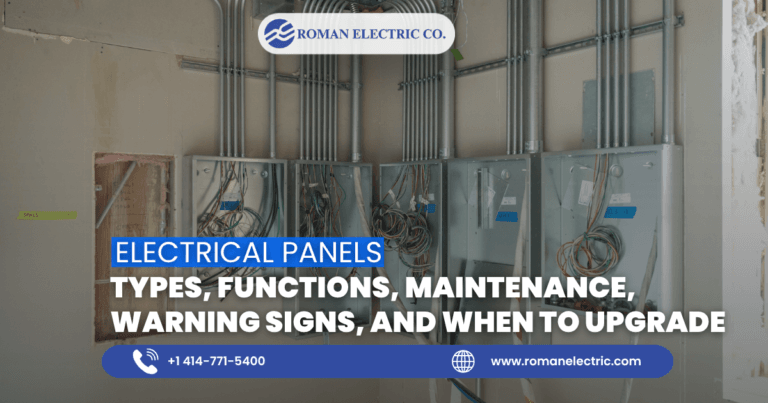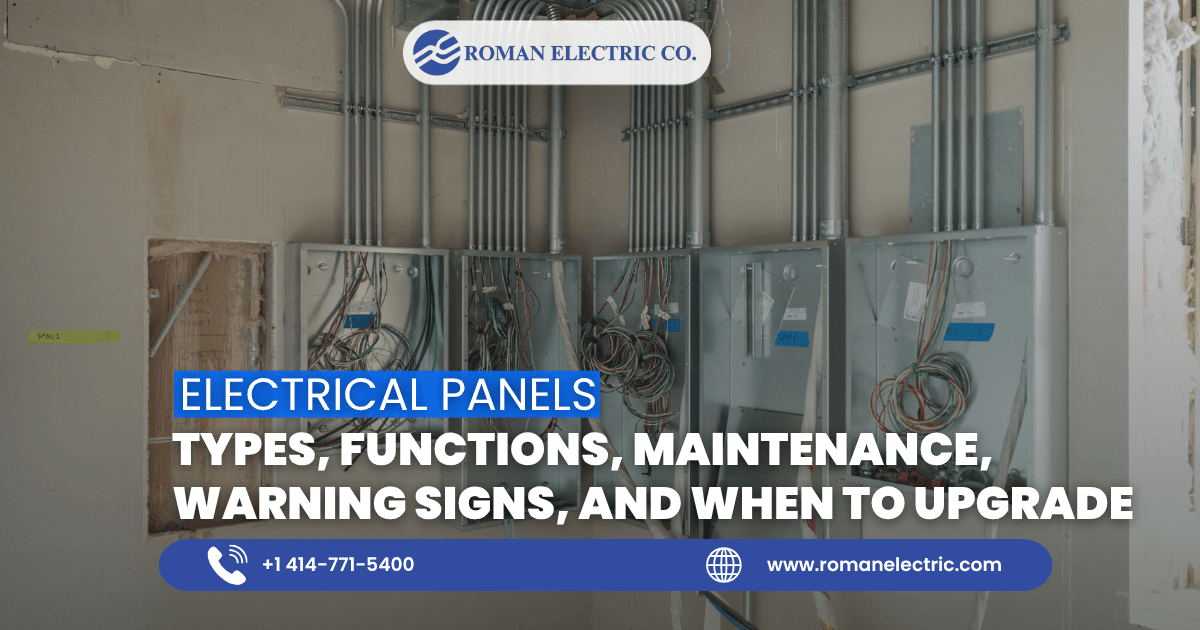
Electrical panels receive electrical power and distribute it among circuits serving lighting, equipment, receptacles, HVAC systems, machinery, and other building loads. In a commercial facility, however, the panel is one component of a larger electrical distribution system. That system may also include service equipment, switchboards, switchgear, transformers, feeders, disconnects, and downstream panelboards.
For a facility manager or commercial property owner, panel age is rarely the most useful starting point. More important questions are whether the equipment remains safe, properly sized, maintainable, compatible with the rest of the electrical system, and capable of supporting the building’s current and planned loads.
A panel can continue operating while no longer being suitable for the facility. An office converted into a restaurant, a warehouse adding EV charging, or a manufacturing facility installing new machinery can create electrical demands that differ substantially from the conditions that existed when the original equipment was installed.The practical decision therefore comes down to equipment condition, present electrical demand, future loads, maintainability, system compatibility, and applicable electrical requirements.
Key Takeaways
- Electrical panels distribute power among protected branch circuits, but their suitability depends on the entire electrical distribution system.
- Panelboards, switchboards, and switchgear perform related distribution functions but are designed for different capacity, protection, fault-performance, and operational requirements.
- Common panel configurations include main breaker panels, main lug-only panels, lighting panels, power panels, and downstream subpanels.
- Empty breaker spaces indicate physical room for additional breakers, not necessarily available electrical capacity.
- Repeated breaker trips, abnormal heat, burning odors, visible damage, corrosion, moisture, or unusual sounds warrant professional investigation.
- Panel age alone does not determine whether equipment should be repaired, replaced, or upgraded.
- Preventive maintenance is more valuable when inspection findings and equipment conditions are documented and compared over time.
- Electrical panel upgrades should be planned around both electrical requirements and facility operations, including shutdowns, critical loads, temporary power, and future expansion.
How Do Commercial Electrical Panels Work?
A panelboard receives power from an upstream source and distributes that power among individual branch circuits. Those circuits may serve lighting, receptacles, HVAC equipment, motors, refrigeration, commercial kitchen equipment, office systems, production machinery, and other loads. A panelboard also houses overcurrent protective devices, such as circuit breakers or fuses, that help protect downstream circuits under specified overload and fault conditions.
A simplified commercial power path can look like this:
Utility or Power Source → Service Equipment → Switchboard or Switchgear → Panelboard → Branch Circuits → Connected Loads
This sequence provides a useful way to understand electrical distribution, but not every commercial property follows the same arrangement. A smaller building may have a relatively straightforward system, while a manufacturing facility, hospital, logistics center, multifamily property, or large commercial building may use transformers, multiple voltage levels, emergency systems, distribution equipment, and specialized loads.
This distinction matters because the panel visible in an electrical room may represent only one layer of the facility’s electrical system. A problem that appears to involve a panel may originate upstream, downstream, or in equipment connected to the circuit.
What Does the Main Breaker Do?
Where a panel includes a main breaker, that device can provide overcurrent protection and a means of disconnecting power to the panel, depending on the particular system design. Individual branch breakers protect downstream circuits.
When a breaker opens because of excessive current or a fault condition, it may be performing its intended protective function. A breaker that repeatedly trips, however, should not simply be reset indefinitely. Repeated trips can indicate excessive loading, defective equipment, damaged wiring, a short circuit, a ground fault, a breaker problem, or another electrical condition requiring diagnosis.
Common Commercial Electrical Panel Types
“Electrical panel” can refer to different types of distribution equipment and configurations. The appropriate choice depends on the electrical system, connected loads, available capacity, and installation requirements. These configurations should not be selected based solely on the number of circuits needed. The panel must also be compatible with the voltage, phase configuration, feeder, available fault current, connected equipment, enclosure requirements, and applicable installation requirements.
Panelboard vs. Switchboard vs. Switchgear
The term “electrical panel” is often used broadly, but panelboards, switchboards, and switchgear are distinct categories of electrical distribution equipment.
| Equipment | Typical Function | General Characteristics | Important Consideration |
| Panelboard | Distributes power among branch circuits | Commonly wall-mounted and often serves lighting, receptacles, and equipment circuits | Circuit requirements, loading, and available capacity |
| Switchboard | Distributes larger amounts of power to downstream equipment | Usually freestanding and used in larger commercial distribution systems | Overall system capacity and downstream distribution |
| Switchgear | Provides distribution, protection, control, and isolation | Heavy-duty construction used in demanding power-distribution applications | Reliability, fault performance, maintainability, and coordination |
Eaton notes that panelboards are generally limited to 1,200 amperes of incoming current, while switchboards can accommodate substantially larger distribution requirements. Actual equipment selection still depends on the specific system design and applicable requirements.
Low-voltage switchgear differs further in construction and protection capabilities. It commonly uses individually mounted power circuit breakers and may be selected where reliability, fault performance, maintenance, or selective coordination are important design considerations.
The practical distinction is that these are not simply larger and smaller versions of the same equipment. Selection depends on how the electrical system needs to distribute, protect, isolate, and control power.
What Determines the Right Electrical Panel for a Commercial Building?
Choosing the right panel requires more than counting breaker spaces or looking at the amperage printed on the equipment.
An evaluation may consider:
- Connected and calculated electrical load
- Service or system voltage
- Phase configuration
- Feeder capacity
- Available amperage
- Available fault current
- Equipment short-circuit ratings
- Number and type of circuits
- Characteristics of connected equipment
- Future electrical loads
- Environmental conditions
- Physical installation space
- Required working clearances
- Maintenance accessibility
- Upstream and downstream equipment
Commercial properties often use three-phase power because many larger motors, HVAC systems, production machines, and other commercial loads are designed for three-phase systems. The more important consideration, however, is whether the existing distribution system remains appropriate for the building’s actual use.
A panel selected for office occupancy may have been entirely suitable when installed. If the property later becomes a restaurant, medical office, production facility, warehouse, or other higher-demand operation, the electrical distribution system may need to be reassessed.
Empty Breaker Spaces Do Not Mean Spare Electrical Capacity
An empty breaker position shows that physical space exists for another breaker. It does not establish that the electrical system has enough capacity for another significant load. Consider a facility planning to install several EV chargers. The panel may have multiple unused breaker positions, but those spaces do not by themselves establish whether the service, feeder, panel, conductors, or upstream equipment can support the additional demand.
The same issue can occur when a facility adds a large HVAC unit, production machine, commercial kitchen equipment, refrigeration equipment, or substantial tenant load.
Before a significant load is connected, the evaluation may need to extend beyond the panel to the feeder, service equipment, existing demand, conductor sizing, upstream protection, and characteristics of the proposed equipment.
The useful rule is:
Panel space answers “Where could a breaker fit?” Capacity analysis answers “Can the electrical system safely support the load?”
Warning Signs an Electrical Panel Needs Professional Attention
Not every electrical-panel problem means the entire panel needs replacement. Certain symptoms, however, justify professional investigation.
Breakers Keep Tripping
A breaker that trips once because of a clear temporary overload may be performing its protective function. Repeated trips are different. The cause could involve excessive loading, faulty connected equipment, damaged downstream wiring, a short circuit, a ground fault, a breaker problem, or another electrical condition.
The appropriate response is diagnosis rather than automatically installing a larger breaker. Increasing breaker amperage without confirming conductor ratings, circuit design, equipment requirements, and applicable electrical requirements can create a serious safety hazard.
The Panel or Breakers Are Abnormally Hot
Electrical equipment can produce heat during normal operation. Excessive or unusual temperatures may indicate loose or deteriorated connections, excessive loading, failing components, or another abnormal condition. Infrared thermography can help identify temperature differences while equipment is operating under suitable conditions. A thermal image may reveal a component or connection that warrants closer investigation before an obvious failure occurs.
Thermal imaging is not a complete electrical inspection by itself. Temperature patterns need to be interpreted in the context of equipment loading, operating conditions, connections, maintenance history, and other findings.
There Is a Burning Odor, Discoloration, or Visible Damage
Burning odors, smoke, melted insulation, scorch marks, damaged breakers, or visible evidence of overheating require prompt attention.
OSHA identifies electrical hazards that include shock, electrocution, fire, and explosion. Visible or sensory evidence of overheating should therefore be treated as a condition requiring qualified evaluation rather than routine maintenance that can simply be postponed.
The Panel Develops Unusual Noise
Some electrical equipment produces normal operating sounds. A new buzzing, crackling, popping, or arcing-type sound is different. The source should be identified by qualified personnel because abnormal noise can be associated with connections, breakers, bus components, or other equipment conditions.
Moisture or Corrosion Is Present
Water intrusion, condensation, corrosion, contamination, or a damaged enclosure can compromise electrical equipment and its components. The appropriate response depends on the location and extent of the damage. Some conditions may require further evaluation, while extensive deterioration may make replacement more appropriate.
Commercial electrical distribution equipment should not be opened, tested, inspected internally, or serviced by unqualified personnel. Electrical work should follow applicable safety procedures and licensing requirements.
What Does Commercial Electrical Panel Maintenance Include?
Preventive maintenance should not be reduced to a generic instruction such as “inspect the panel once a year.” The appropriate maintenance program depends on the equipment, manufacturer instructions, operating environment, equipment condition, duty cycle, system criticality, and applicable maintenance requirements.
NFPA 70B, Standard for Electrical Equipment Maintenance, provides requirements and practices for establishing and maintaining an electrical equipment maintenance program.
Depending on the equipment and operating conditions, maintenance may include:
- Visual inspection for damage, moisture, contamination, and deterioration
- Checking for evidence of overheating
- Evaluating breaker condition
- Examining connections where appropriate
- Infrared scanning under suitable operating conditions
- Cleaning using appropriate procedures
- Testing or exercising equipment where required
- Reviewing labels and panel schedules
- Checking documentation and maintenance records
- Reviewing access and working clearances
Maintenance intervals and procedures should be based on the actual equipment and operating conditions rather than copied from a generic online checklist.
Maintenance Records Can Be More Valuable Than a Single Inspection
A one-time inspection provides a snapshot of equipment condition on a particular day. A documented maintenance history can show whether conditions are stable, improving, or deteriorating. For example, suppose a thermal scan identifies elevated temperature at a connection. A later scan performed under comparable loading can provide useful information about whether the condition has changed.
Maintenance records may include previous thermal images, inspection findings, breaker problems, repairs, equipment additions, and significant load changes. This historical context is particularly valuable in manufacturing, healthcare, logistics, refrigeration, multifamily housing, and other facilities where an electrical failure can create substantial operational disruption.
Electrical Panel Repair vs. Replacement vs. Upgrade
Repair, replacement, and upgrade are often used interchangeably, but they describe different decisions.
When Does Repair Make Sense?
Repair may be appropriate when a specific problem can be corrected properly and the overall panel remains suitable, supportable, and adequate for the electrical system. An isolated defective component or connection problem does not automatically mean the entire panel needs to be replaced.
Repair becomes less attractive when damage is widespread, replacement parts are unavailable, equipment is difficult to support, deterioration is recurring, or the panel no longer meets the facility’s electrical requirements.
When Does Replacement Make Sense?
Replacement generally involves removing equipment that is damaged, unreliable, obsolete, unsupported, or otherwise no longer suitable and installing new equipment that performs substantially the same distribution function. Even a replacement should not automatically be treated as a simple box-for-box exchange.
The project may require consideration of feeders, grounding and bonding, working clearances, equipment ratings, fault-current conditions, available capacity, and applicable requirements.
When Is an Upgrade Different?
An electrical panel upgrade changes or increases capability. A facility may need an upgrade because existing distribution equipment cannot support new machinery, expanded HVAC, EV charging, a building addition, a tenant conversion, or another significant change in electrical demand.
A practical decision model is:
| Existing Condition | Typical Direction |
| Isolated problem and equipment remains suitable | Repair |
| Equipment is damaged, unreliable, unsupported, or no longer maintainable | Replace |
| Electrical system cannot adequately support present or planned demand | Upgrade |
This framework helps organize the decision, but the actual installation still requires evaluation of the specific electrical system.
When Should a Commercial Electrical Panel Be Upgraded?
Age alone is not a sufficient reason to upgrade an electrical panel.
A well-maintained older panel that remains properly applied, supportable, and adequate for the building’s electrical demand presents a different situation from newer equipment that is damaged, overloaded, incorrectly applied, or unable to support planned loads.
An upgrade becomes more relevant when a facility:
- Adds major machinery or production equipment
- Expands HVAC capacity
- Installs EV charging infrastructure
- Undergoes a major renovation
- Changes occupancy or building use
- Expands production or floor area
- Adds substantial tenant loads
- Experiences limitations in the existing distribution system
- Has obsolete or difficult-to-source components
- Requires additional circuits or distribution capacity
Parts availability can also affect the decision. Equipment that remains operational may become increasingly difficult to maintain when appropriate replacement components are no longer available.
Start With the Load, Not the Panel Catalog
A common planning mistake is selecting new panel equipment before determining what the electrical system actually needs.
A better sequence is:
Current Demand → Planned Loads → Service Capacity → Feeder Capacity → Fault Conditions → Distribution Requirements → Future Growth → Equipment Selection
This approach answers a more useful question than:
“Which panel should we buy?”
It asks:
“What must the electrical system support now, and what is it likely to support next?”
Starting with the load can help prevent a facility from installing an upgrade that solves an immediate capacity issue but provides little flexibility for a known future expansion.
What Should Facility Managers Review Before a Panel Assessment?
A facility manager does not need to diagnose electrical equipment personally to provide useful information to an electrical professional.
Before an assessment, it can help to document:
| Information to Review | Why It Matters |
| Recurring breaker trips | Helps identify patterns and affected circuits |
| Recent equipment additions | Shows changes in electrical demand |
| Planned machinery or HVAC | Identifies future load requirements |
| EV charging plans | Helps determine potential additional demand |
| Previous inspection reports | Provides equipment history |
| Thermal imaging records | Allows comparison of temperature trends |
| Panel schedules | Helps establish circuit documentation |
| Maintenance records | Shows previous problems and repairs |
| Equipment or component age | Can affect supportability and replacement planning |
| Critical building loads | Helps plan shutdowns and operational continuity |
This information does not replace a professional electrical assessment. It gives the electrical team a clearer picture of the building’s history and intended use before evaluating the system.
Plan Electrical Panel Upgrades Around Operations
In a commercial facility, an electrical panel upgrade is not only an electrical-design project. It can also be an operations project. Replacing or modifying distribution equipment may require power to be disconnected from affected portions of the building. The consequences depend on what those circuits serve.
A brief outage in an unoccupied office may be manageable. An outage affecting production machinery, refrigeration, servers, security systems, medical equipment, elevators, tenant operations, or other critical loads may require significantly more planning.
Before work begins, facility managers should determine:
- Which systems will lose power
- How long critical systems can remain offline
- Whether temporary power is required
- Whether the work can be phased
- Whether utility coordination is necessary
- Whether permits or inspections are required
- Whether evening or weekend work would reduce disruption
- Whether downstream equipment requires controlled shutdown or restart
- Whether critical loads need a temporary or alternative power strategy
Some facilities can reduce disruption through evening or weekend scheduling. Others may require a detailed temporary-power or phased-work plan.
The useful principle is:
The best electrical solution is not fully planned until the facility understands how the work will affect operations.
Electrical Panel Safety and Code Compliance
Electrical panels are energized distribution equipment, not ordinary building hardware. OSHA maintains electrical safety requirements intended to protect workers from electrical hazards. NFPA 70E addresses electrical safety in the workplace, including safety-related work practices. NFPA 70, the National Electrical Code, establishes requirements for electrical design and installation.
The publication of a new national NEC edition should not be confused with local enforcement. States and jurisdictions adopt electrical codes through their own regulatory processes and may use different editions or amendments. For that reason, the requirements governing a commercial panel project should be verified for the actual project location, building, and scope of work.
This is particularly important in Wisconsin, where state electrical requirements, licensing rules, inspections, and project-specific conditions can affect commercial electrical work.
A practical compliance sequence is:
Identify the Project → Verify Applicable Requirements → Evaluate the Existing System → Design the Work → Obtain Required Approvals → Perform and Inspect the Installation
Electrical panel work should be performed by appropriately qualified professionals within the scope of applicable state and local requirements.
Electrical Panels in Milwaukee and Southeastern Wisconsin
The fundamental principles of electrical panel capacity, maintenance, and distribution do not change simply because a facility is located in Milwaukee. Local considerations become important when code adoption, permitting, inspections, licensing, utility coordination, facility conditions, and project scheduling affect the work.
Wisconsin’s Department of Safety and Professional Services oversees electrical licensing and state electrical requirements. Because requirements can change through state rulemaking and local project conditions, facility managers should verify the rules that currently apply to their specific project rather than assuming that the newest national NEC edition automatically governs the work.
Roman Electric serves commercial facilities throughout Milwaukee and Southeastern Wisconsin, including the Milwaukee metropolitan area, Waukesha County, Racine, Kenosha, and surrounding communities.
For a local facility manager evaluating an electrical panel, the practical process is:
Understand Current Load → Identify Planned Demand → Review Existing Equipment → Identify Critical Operations → Verify Applicable Requirements → Determine Repair, Replacement, or Upgrade Strategy
This approach is more reliable than deciding in advance that an older panel must be replaced. It is also more reliable than assuming an empty breaker position means additional equipment can simply be connected.
Need Help Evaluating a Commercial Electrical Panel?
Determining whether a commercial electrical panel should be repaired, replaced, or upgraded requires more than looking at the panel’s age or counting available breaker spaces.
Roman Electric provides commercial electrical construction, maintenance, troubleshooting, infrared scanning, power-distribution, renovation, and related electrical services throughout Milwaukee and Southeastern Wisconsin.
A professional evaluation can help facility managers understand existing equipment condition, electrical capacity, recurring problems, planned load requirements, and operational constraints before deciding on the appropriate next step.
The goal is not simply to install a new panel. It is to make sure the electrical distribution system safely and reliably supports the facility’s needs today while allowing for practical future growth.
Frequently Asked Questions
1. What is the main purpose of a commercial electrical panel?
A commercial electrical panel receives power from an upstream source and distributes it to branch circuits serving lighting, HVAC systems, receptacles, machinery, and other building equipment. Circuit breakers or fuses provide overcurrent protection for downstream circuits as part of the electrical distribution system.
2. What are the main types of commercial electrical panels?
Common commercial panel configurations include main breaker panels, main lug-only panels, lighting panels, power panels, and downstream subpanels. Larger distribution systems may also use switchboards and switchgear. The appropriate equipment depends on system voltage, phase, capacity, fault conditions, connected loads, and project requirements.
3. Can an electrical panel have empty breaker spaces but still be at capacity?
Yes. Empty breaker spaces indicate physical room for additional breakers, not confirmed electrical capacity. Existing demand, service capacity, feeder size, panel ratings, voltage, phase configuration, and the proposed load should be evaluated before adding significant equipment.
4. What causes circuit breakers to keep tripping?
Repeated breaker trips can result from excessive loading, faulty equipment, damaged wiring, short circuits, ground faults, breaker problems, or other downstream conditions. The underlying cause should be diagnosed before deciding whether the breaker or panel needs repair or replacement.
5. When should a commercial electrical panel be replaced or upgraded?
Replacement may be appropriate when equipment is damaged, unreliable, obsolete, unsupported, or difficult to maintain. An upgrade may be necessary when the existing electrical system cannot adequately support current or planned demand, such as new machinery, expanded HVAC, EV charging, building additions, or significant occupancy changes.
6. Does an old electrical panel automatically need to be replaced?
No. Age alone does not determine whether a panel needs replacement. Equipment condition, capacity, maintenance history, component availability, system compatibility, safety considerations, and future electrical demand are more useful decision factors.
7. How often should commercial electrical panels be inspected?
There is no single inspection interval that applies to every commercial facility. Maintenance frequency should take into account the equipment, manufacturer instructions, operating environment, condition, system criticality, operating history, and the facility’s electrical maintenance program.
8. Is thermal imaging enough for an electrical panel inspection?
No. Infrared thermography is a useful diagnostic tool for identifying abnormal temperature patterns under suitable operating conditions, but it is not a complete electrical inspection. Thermal findings should be evaluated alongside equipment condition, loading, connections, maintenance history, and other inspection results.
9. Can a new machine be added if the electrical panel has an empty breaker space?
Not necessarily. An empty breaker position provides physical space but does not prove that the service, feeder, panel, conductors, or upstream equipment can support the machine. The proposed load should be evaluated as part of the complete electrical distribution system.