A Milwaukee warehouse owner returned to work Monday morning to find a break-in at the back door of the business. Three apparatuses were missing from the equipment. No recording. Access log absent. There was nothing; the police would find nothing except the broken lock and sick feeling in my stomach. He has company. This occurs more than one thinks. The issue was not that he didn’t care about safety. The issue was that he had a basic camera setup that wasn’t plugged into the building’s electrical system. It was not online over the weekend. No one was aware until it was too late. That is the difference between a camera on a wall and a real commercial security systems. One gives you a false sense of safety. The other actually protects your business.
What Business Owners Get Wrong About Commercial Security Systems
Most people think security means cameras. Buy a few, stick them in the corners, done. However, it does not happen in a real commercial building. A warehouse cannot be a house. A building that has 200 employees is not an apartment. The dangers are dissimilar. The foot traffic is different. The number of entry points is different. And the electrical demands of running a full security setup are completely different.
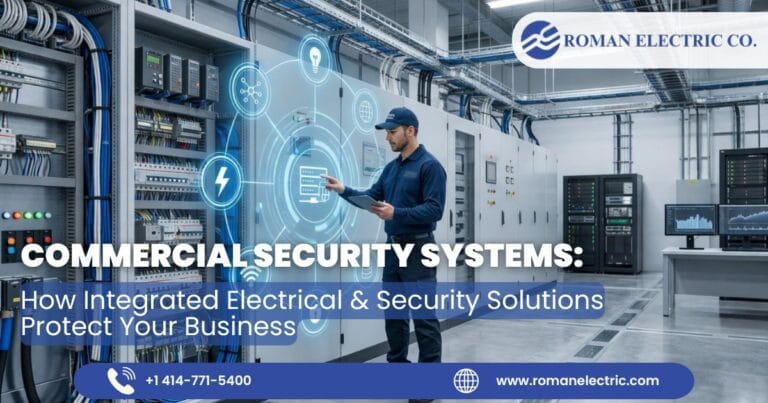
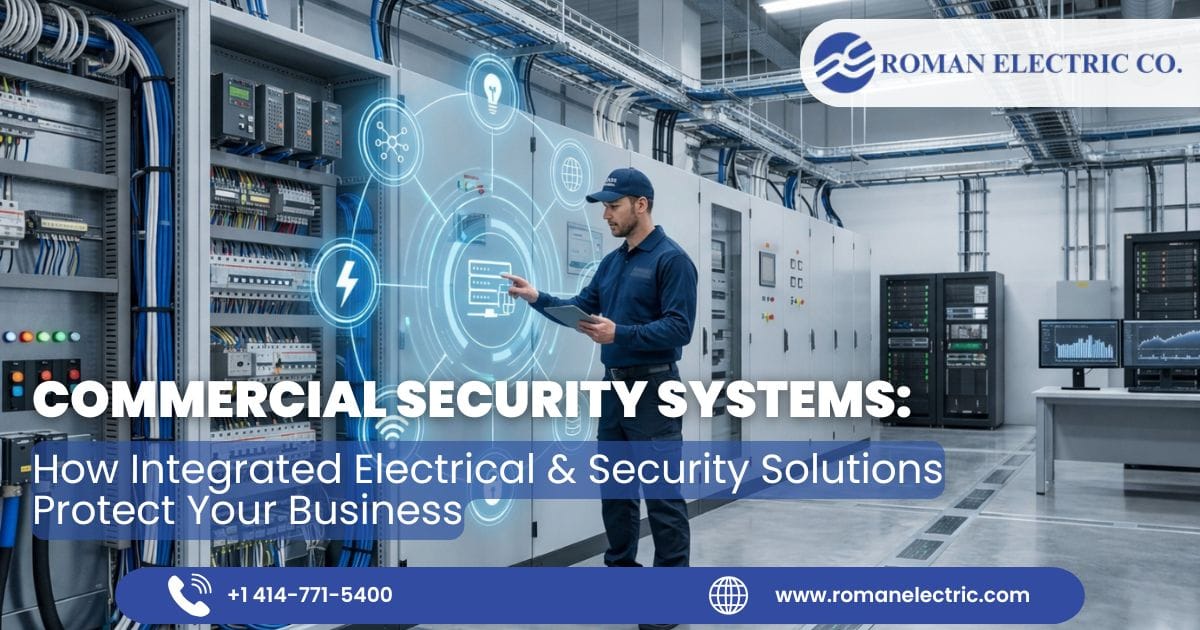
Commercial security systems are built around your whole building. Cameras, yes. But also access control, motion sensors, alarm panels, intercoms, backup power, and network cabling. All of it working together.
And here is the part most security companies never tell you. If that system is not tied into a stable, properly designed electrical infrastructure, it will let you down. Cameras flicker. Access panels freeze. Alarms fail to trigger. The electrical side is not an afterthought. It is the foundation.
Why the Electrical and Security Connection Matters So Much
Think about what happens during a storm in Milwaukee. Power flickers. Surges run through the lines.
A security camera running on a poor electrical connection will go offline. An access control panel without a dedicated circuit can reset and lose its programming. A motion sensor on a shared circuit can give false readings when other equipment kicks on. These are real problems that happen in real buildings every week.
When your commercial security systems are wired into a solid electrical setup with dedicated circuits, proper grounding, and backup power, you do not have those problems. Your cameras stay on. So, your alarms stay armed. Your access logs keep recording.
That is the whole point of integrated solutions. Not just hooking up a camera to a wall outlet. Actually building a system where every piece supports every other piece.
Roman Electric handles both sides of this. Our electricians and security technicians work as one team. Check out our Commercial Electrical Service and Maintenance page to see how we approach building infrastructure.
What a Complete System Actually Looks Like
Here is a simple breakdown of the components that go into a well-built commercial security setup:
| Component | What It Does | Why It Matters |
| IP Camera Systems | Continuous video recording and live monitoring | Evidence, deterrence, liability protection |
| Access Control | Manages entry to specific areas by person or time | Stops unauthorized access cold |
| Intrusion Alarms | Detects unauthorized entry | Sends alerts before damage is done |
| Intercom and Video Entry | Screens visitors before they enter | Keeps the front door under your control |
| Motion Sensors | Triggers alerts or lighting in restricted zones | Catches activity in blind spots |
| Structured Network Cabling | Connects all devices cleanly and reliably | No signal drops, no dead zones |
| Backup Power Systems | Keeps everything running during outages | No gaps in coverage when it matters most |
Every one of these components needs proper power. Every one of them needs proper cabling. Skip that part and the whole thing becomes unreliable.
Which Businesses Actually Need This
Short answer? Most of them. But the risks vary by industry. Here is what tends to show up most often:
Office Buildings
Lots of employees. Contractors coming in and out. Visitors who may or may not belong in certain areas. Access control is not optional here. You need to know who is where and when.
Retail Stores
Shoplifting is obvious. But internal theft from employees is actually a bigger problem for most retailers. Good camera coverage in stockrooms and at registers changes behavior fast.
Manufacturing Facilities
Heavy equipment, raw materials, and restricted machinery. One unauthorized person in the wrong area is a safety incident waiting to happen. Zoned access and perimeter cameras are essential.
Warehouses and Distribution Centers
Big buildings. Long hours. Lots of blind spots. Night shifts where fewer people are watching. This is exactly where integrated lighting triggers and motion-activated cameras pay for themselves.
Healthcare and Medical Offices
Patient privacy, medication storage, restricted records. There are legal requirements around security in healthcare settings. A proper system keeps you compliant and your patients protected.
Restaurants and Food Service
Cash on hand every night. High employee turnover. Food theft. A camera system in the right spots keeps losses down and gives you something solid to fall back on when disputes come up.
How the Installation Process Actually Works
This is where many business owners feel very uncertain. They do not want to shut down their building for a week or have a messy installation.
Here is how a professional job actually goes:
Site Walkthrough First
Before anything gets ordered or planned, a technician walks your building with you. They look at every entry point, every blind spot, every area that carries risk. They also look at your electrical panel, your existing wiring, and where conduit can be run cleanly.
A Plan Built for Your Building
You get a real design. Camera locations on a floor plan. Cable routes mapped out. Power requirements calculated. Nobody shows up and starts drilling without a clear picture of what the finished system looks like.
Electrical Prep Comes Before Equipment
Dedicated circuits get run. Conduit gets installed. Backup power connections get made. This is the part most security-only companies skip or farm out. Roman Electric does it in-house with licensed electricians.
Equipment Installation
Cameras go up in the right spots, not just the convenient ones. Access panels get mounted at the right height with the right backing. Sensors get placed where they will actually catch something. Cabling gets run clean and labeled properly.
Testing Before We Leave
Every camera gets checked. So, every sensor gets triggered. Every access point gets tested. You watch it work before we consider the job done.
Training for Your Team
You and your staff learn how to use the system. How to pull footage. So, how to add or remove access credentials. How to read an alert. No one gets left with a bunch of equipment they do not understand.
The Real Cost of Skipping Security
Some business owners look at a security system quote and push it to next quarter. Then next year. Then something happens.
A break-in at a commercial property can cost as much as $8,000 to $20,000 which includes stolen equipment, property damage, downtime and insurance stress afterwards.
Employee theft is quieter but it adds up just as fast. Studies from the retail industry consistently show internal theft outpaces shoplifting in terms of total dollar loss.
And then there is the liability angle. A slip and fall with no footage. A harassment complaint with no access log. A dispute with a vendor and no record of who was in the building that day. Without documentation, you are exposed.
The U.S. Small Business Administration notes that crime and security risks are among the most common causes of unexpected financial losses for small and mid-size businesses. A properly installed system is one of the most direct ways to protect against that.
Remote Access Changes Everything
Ten years ago, monitoring your building meant hiring a guard or sitting in front of a monitor. Today you pull out your phone.
Modern commercial security systems let you watch live feeds from anywhere, get a text or app alert the moment an alarm triggers, lock or unlock a door remotely, see a full log of who entered which door and when, and get notified if any camera goes offline.
For business owners with multiple locations, this is a game changer. You are not guessing what is happening at your second building across town. You can see it.
FAQs About Commercial Security Systems
Q: Is there a big difference between commercial and residential security systems?
A: Yes, a significant one. Commercial systems handle more devices, more users, larger spaces, and more complex access needs. They also require proper electrical infrastructure to stay reliable.
Q: Can an older building in Milwaukee be upgraded?
A: Almost always yes. The site assessment will show what electrical prep is needed. Most older buildings can handle a full upgrade without major construction.
Q: Do we need permits for security installation in Wisconsin?
A: Depending on the scope, yes. Low-voltage wiring and access control work often require permits. Your contractor should pull those and manage the inspection process.
Q: How long will the installation take?
A: A smaller office might be done in a day or two. A larger facility with complex access control could take one to two weeks. Your contractor should give you a clear timeline before work starts.
Q: Can employees use their phones or key cards for access control?
A: Yes. Most modern access systems support mobile credentials, key cards, key fobs, and PIN codes. You choose what works for your operation.
Conclusion
A camera in the corner is not a security system. A sticker on the window is not protection. Real commercial security systems are designed, installed, and powered correctly from the ground up.
When electrical systems and security systems are designed to work well together, you get a setup that works in the real world. Blackouts, spikes, congestions, irregular-hour operations. It keeps running. It keeps recording. So, it keeps your building, your equipment, and your people protected.
Roman Electric has been doing this kind of work in Southeastern Wisconsin since 1929. We are not a security company that figures out the electrical part as they go. We are a full electrical and security contractor with nearly 100 years of experience behind every project.
If you are ready to stop guessing whether your building is protected and actually know that it is, reach out to us. Contact Roman Electric today to schedule a site assessment and get a quote for commercial security systems that are built to last. Our team is reachable 24 hours a day at 414-771-5400.