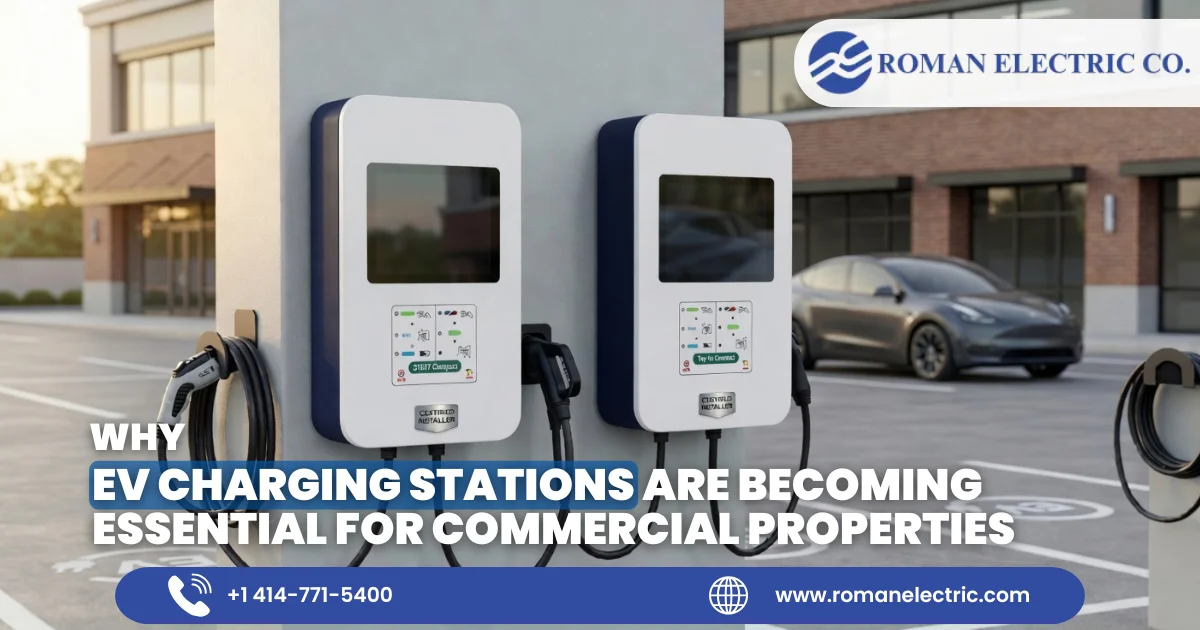
More and more commercial property owners are starting to take the plunge with the commercial installation of EV charging stations. Those who took the initiative early are already benefiting from it. You’re right, electric vehicles are not a niche product for early adopters anymore. Every street, every parking lot, and an ever-growing proportion of the workforce and clientele that companies depend on every day belong to them.
Those business operators and property owners who see the change and react to it in an appropriate way are well placed. At Roman Electric, we have been installing commercial EV charging infrastructure for businesses throughout the area. The conversations property owners are having or have had in the past couple of years have changed quite a bit.
The EV Market Has Shifted Faster Than Most People Expected
A few years ago it was reasonable to treat EV charging as a forward-thinking amenity. Something progressive businesses added to signal their environmental values. That framing doesn’t really hold anymore.
EV sales have grown dramatically. More and more people drive electric vehicles now than ever before & that number climbs every quarter. Most areas haven’t kept pace with adopting the infrastructure to support those vehicles, which means EV drivers are actively making decisions about where they shop, work, eat & spend time partly on whether charging is available.
This is a real behavioral pattern that property owners can either respond to or ignore. The businesses responding to it are seeing tangible returns.
Why Commercial Properties Specifically Need to Pay Attention
Charging an electric vehicle at home is easy. A person connects and charges their device at home. Commercial properties have a different purpose. People tend to frequent at times for hours on end. It is the duration for which the vehicle is kept at the charging station that matters.
People who charge while they shop, eat, or work out don’t have to take a detour to a charging station. Since they already created the option, charging is a secondary consideration. The convenience factor is so impactful that people are often increasingly choosing to spend their time and money at more convenient locations.
Employers, too, have the same dynamic. Employees who can charge while at work tend to be more loyal. It eliminates a logistical inconvenience from their daily routine that really matters to them.
Commercial EV Charging Station Installation: What It Actually Involves
When property owners know what the installation process entails, they can plan accordingly.
The installation of a charging station for commercial EVs is slightly more complex than a residential installation due to electrical capacity requirements, the number of units typically required, and the need for proper load management of the property’s overall electrical system.
At Roman Electric, we assess the existing electrical infrastructure of a property before recommending a charging solution. The capacity of the main service, the condition of the distribution system, and the physical layout of the parking area all factor into what’s possible and what makes the most practical sense for the specific property.
Level 2 chargers are the standard for most commercial applications. They deliver a meaningful charge during a typical visit without requiring the infrastructure investment of DC fast charging. For properties where vehicles stay for extended periods like offices, hotels, and parking garages, Level 2 is usually the right choice. For properties like fuel station forecourts or quick service locations where dwell time is short, DC fast charging becomes more relevant.
Here is a straightforward comparison of the main charging options for commercial properties:
| Charging Level | Power Output | Charge Time | Best For |
| Level 1 | 1.4 kW | 8 to 20 hours | Rarely suitable for commercial use |
| Level 2 | 7 to 22 kW | 1 to 8 hours | Offices, retail, hotels, gyms |
| DC Fast Charging | 50 to 350 kW | 20 to 60 minutes | High-turnover locations |
The Business Case for Commercial EV Charging
Property owners sometimes look at EV charging as a cost without fully working through the return side of the equation. The business case is stronger than many people initially assume.
Attracting and retaining tenants. EV charging is increasingly becoming a tenant expectation for commercial landlords similar to broadband and HVAC equipment according to a report by the Financial Post. Properties that lack this are at a disadvantage in competitive leasing markets.
Customer dwell time and spending. Retail and hospitality research consistently shows that customers who are charging spend more time on a property and make more purchases during that time. The charging infrastructure effectively pays for itself through increased revenue from existing visitors.
Employee satisfaction and recruitment. Companies offering workplace charging report that it is valued by employees who drive EVs and serves as a genuine differentiator in recruitment, particularly for roles where candidates have options.
Property value. Properties with established EV charging infrastructure are increasingly valued higher than comparable properties without it as the market for EV-capable real estate develops.
Revenue generation. Charging stations can be configured to charge users per session or per kilowatt hour, turning the infrastructure into a direct revenue stream rather than just a cost center.
Federal Incentives That Change the Financial Calculation
The Inflation Reduction Act passage has significantly enhanced the financial rationale for installing commercial electric vehicle charging stations. Tax credit known as the Alternative Fuel Vehicle Refueling Property Credit, the 30C tax credit for the installation of electric vehicle charging equipment at commercial premises provides for a tax credit equal to 30 percent of the cost of qualified EV charging equipment subject to location and prevailing.
According to the U.S. Department of Energy, significant federal and state funding remains available for commercial EV charging infrastructure through multiple programs. Property owners who haven’t looked at the current incentive landscape recently may be working with outdated assumptions about what installation actually costs after credits and incentives are applied.
State and utility incentive programs add to the federal credits in many cases. Working with an electrician familiar with the current incentive landscape helps property owners capture the full benefit available to them.
Code Compliance and Permitting for Commercial Installations
The installation of commercial electric vehicle charging stations must adhere to local electrical regulations. Moreover, the installation of the station must also conform to the building regulations in the area. The permitting process of commercial installations is more involved than residential work and require working with a licensed commercial electrical contractor who understands the permitting processes in your area.
The National Electrical Code supplies the basic regulations regarding EV charging installations, but there are various amendments and interpretations. By being correct from the start, it avoids expensive corrections down the line and ensures no delays in installation inspection.
Roman Electric handles the permitting process as part of every commercial EV charging installation. Property owners don’t need to navigate that process alone.
Planning for Future Capacity
Installing the least infrastructure possible for commercial EV charging station is one of the biggest mistakes, as demand never remains the same in the future.
Having the conduit and electrical capacity ready for future charging stations when the first charging station is installed costs a fraction of what a retrofit would cost to add that conduit and capacity later. Building properties with expansion in mind eliminates the added cost and disruption of a second major intervention if demand exceeds the initial project.
The EV adoption curve has consistently moved faster than early projections. Planning conservatively on capacity has been the wrong call for most of the past decade and that pattern is unlikely to change.
Networked charging equipment that provides remote monitoring, load management, and usage reporting is worth the additional upfront cost for commercial properties. The visibility into how the infrastructure is being used, and the ability to manage load intelligently across multiple stations, has real operational value.
What to Look for in a Commercial EV Charging Contractor
Not every electrical contractor has genuine experience with commercial EV charging infrastructure. The scale and complexity of commercial installations is different from residential work in ways that matter.
Experience with the specific charging equipment you’re considering is important. Different manufacturers have different installation requirements and integration considerations. A contractor who has installed that equipment before will do the job more efficiently and avoid the learning curve mistakes that show up in projects handled by less experienced crews.
Understanding of load management and demand charge implications is critical for larger installations. Adding significant EV charging load to a commercial property without proper load management can trigger demand charges from the utility that significantly affect the operating economics of the installation.
Familiarity with available incentive programs helps property owners capture credits and rebates they might otherwise miss. A contractor who keeps current with the incentive landscape adds real value beyond just the installation itself.
FAQs
Q: How many EV charging stations does a commercial property typically need?
A: It depends on the property type, the number of parking spaces, and the expected EV adoption rate among users. A common starting point is 5 to 10 percent of parking spaces, with infrastructure in place to expand.
Q: How much does commercial EV charging station installation cost?
A: Costs vary significantly based on the number of units, the existing electrical infrastructure, and the type of chargers selected. Level 2 commercial installations typically range from a few thousand dollars per station before incentives are applied.
Q: Do commercial EV charging stations require ongoing maintenance?
A: Yes. Networked charging equipment requires software updates and occasional hardware maintenance. Most commercial charging equipment manufacturers offer service agreements.
Q: Can EV charging stations generate revenue for property owners?
A: Yes. Stations can be configured to charge users per session or per kilowatt hour. Some property owners cover operating costs entirely through user fees.
Q: How long does a commercial EV charging installation take?
A: A straightforward installation of a small number of Level 2 stations can be completed in one to two days. Larger installations requiring electrical service upgrades take longer depending on utility involvement.
Q: Are there ADA requirements for commercial EV charging stations?
A: Yes. ADA guidelines require that a percentage of EV charging spaces meet accessibility standards for van-accessible spaces and maneuvering clearances.
Conclusion
Commercial EV charging station installation has moved from a forward-thinking amenity to a practical business necessity for commercial properties that want to stay competitive and relevant to the customers, tenants, and employees they serve. The financial case is stronger than many property owners realize once incentives are factored in and the revenue, retention, and property value benefits are properly accounted for. The properties that act now rather than waiting until the demand becomes impossible to ignore are the ones that will have infrastructure in place when everyone else is scrambling to catch up. If you’re ready to explore what commercial EV charging station installation would look like for your property, visit Roman Electric and talk to a team with real hands-on experience delivering commercial EV charging infrastructure that works properly from day one.