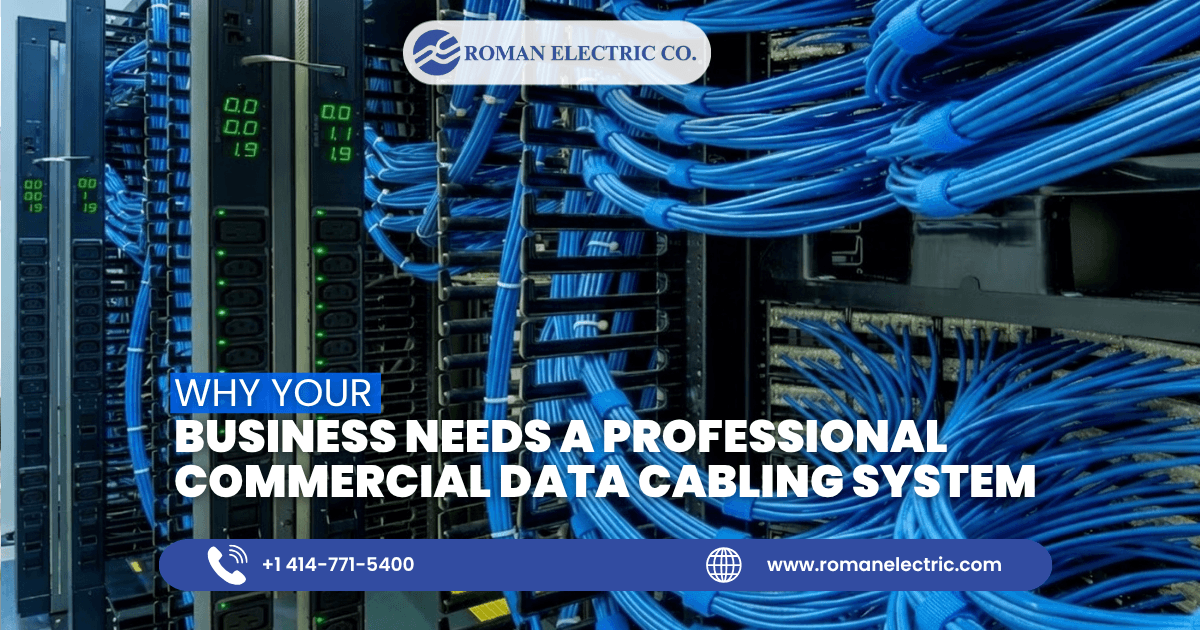
May I ask you something? Have you been in the middle of a meeting and suddenly lost wi-fi connection? Or maybe your team is constantly complaining that the network is slow while you are paying for high-speed internet? People don’t always realize it happens. Usually, it’s not your internet provider that’s the problem. Your building contains cabling inside.
Poorly done wiring is stealthy. It is not visible. Nonetheless, you experience it daily through slow speeds, intermittent drop-outs, and an IT guy who says he cannot figure out what’s wrong. It resolves everything with a suitable commercial data cabling system. It’s not about magic: it’s about doing things right from the very start.
What Is a Commercial Data Cabling System?
In simpler terms, the physical cabling connects everything we do in the office. Your computers, phones, printers, cameras, wireless access points, and servers connect through cables. That’s right; if those cables are installed correctly with the right materials and plan, all is well. When things do not work the way they should, do nothing.
Structured systems are used for professional cabling. Ethernet cables like Cat6 or Cat6A, fiber optic lines over long distances, patch panels and labelled ports, and organization of cables through the wall and ceiling. Connection requires careful setup of equipment. The aim is to make something functional that can last for years.
Professional cabling systems follow proper structured cabling standards defined by the Telecommunications Industry Association to ensure stable and high-speed network performance.
Why Your Business Cannot Afford to Skip This
1. Your Network Speed Depends on It
People spend thousands on internet plans, yet still feel it is not fast enough. This is the reality. Old, faulty, or poorly installed cabling creates a bottleneck for your network performance. Data movement cannot accelerate to the speed it ought to. Good cabling eliminates that bottleneck. As easy as that.
2. Network Problems Cost Real Money
A network downtime on an hourly basis will result in no work productivity. Workload is increasing. Customers feel irritated. The more time it takes for your IT person to find the issue, the more it will cost you. When a cabling system is well-structured and labeled, issues are resolved in minutes. This, in itself, saves money and time again.
3. You Will Eventually Grow
Businesses change. You add staff. You move to a bigger office. So, you set up a new department. If your cabling was thrown together without a plan, adding anything new becomes a nightmare. Professional cabling is built with expansion in mind. Adding a new workstation later is easy when the foundation is already solid.
4. One System for Everything
Your office network carries more than just computer traffic. Phones, security cameras, access control, smart devices, wireless access points. All of it runs on the same network. A well-built cabling system handles all of this without things stepping on each other. No slowdowns, no conflicts, no chaos.
5. Safety Is Not Optional
This one surprises people. Badly installed cabling is a real fire hazard. The problem may also violate building codes and create insurance issues. Professional installers adhere to standard practices while leveraging advanced techniques to ensure compliance and safety. You do not want to find this out the hard way.
6. A Clean Office Is a Better Office
A chaotic office with wires running everywhere instantly gives you a bad vibe when you walk in. Extension cords stuck in switches, wires taped to the ground, random sockets on walls. It looks bad, it slows down maintenance, and honestly, it is just stressful. Professional cabling means everything is hidden, organized, and clean.
7. Cheap Cabling Costs More Later
Every business owner comes to learn this eventually. You attempt to save money upfront by cutting corners or doing it yourself. Afterward, you waste the next five years basically paying for repairs, call-outs, and eventually a full reinstallation anyway. The cost-effectiveness of doing it right the first time.
Professional Cabling vs DIY Cabling
| Feature | Professional Cabling | DIY or Cheap Cabling |
| Network Speed | Fast and consistent | Unreliable, often slow |
| Downtime Risk | Very low | High |
| Scalability | Easy to expand later | Messy and costly to change |
| Safety Compliance | Fully up to code | Often non-compliant |
| Maintenance | Quick, everything is labeled | Confusing and time-consuming |
| Long-Term Cost | Lower overall | Higher due to constant issues |
What Actually Happens During a Professional Installation
Many people assume that it involves merely showing up and running a few cables. It is not. There is a correct procedure.
The initial step is a site survey. The experts tour the area, analyze where everything will go and what’s the best route to take, draw up a whole plan before even touching a cable. What most DIY jobs miss entirely, and the exact reason they fail.
They then choose the appropriate cables. Different offices require different essential items. The appropriate cable type depends on how far the runs are, what speed you need, and what your budget looks like. An efficient installer selects the appropriate resource for the task.
After that is the actual installation. Cables can run through walls and ceilings. Everything is properly secured. Nothing is just taped to something or tied up and left hanging.
After that, each cable gets terminated and is effectively labeled at the patch panel. Legible tags. Port de s’organiser Future workers on your network will come to terms with the information presented here.
Finally, every single run gets tested. Not just plugged in and assumed to work. Tested with proper equipment, verified against performance standards, and documented. You get a report. That is how you know it was done right.
How to Pick the Right Cabling Company
This part matters more than people realize. Not every electrician or IT company actually knows how to design and install a proper commercial cabling system. Some of them just wing it. You do not want that.
At romanelectric.com, commercial data cabling is taken seriously from the first conversation to the final test report. The work is planned properly, installed cleanly, and documented so your team always knows what is what.
A few things to check when hiring someone. Are their technicians actually certified in structured cabling? Do they follow recognized standards like TIA/EIA-568? Can they show you examples of past commercial work? Is their quote clear with no hidden costs? If the answers are yes, you are probably in good hands.
Signs Your Current Setup Is Already a Problem
Sometimes people are not sure if their cabling is actually the issue. Here are some things that usually point to it.
Your internet feels slow even though you pay for a fast plan. Some parts of the office have no connection at all. Your IT person dreads going into the server room. You keep running out of ports when you add new devices. The cables you can see are old, cracked, or a complete mess. The network drops randomly and nobody knows why. And if your cabling was installed more than ten years ago and never touched since, that is a problem waiting to get worse.
Even one of these is worth taking seriously.
The Bigger Picture
Think about everything your team does in a day. Every email, every call, every file, every application. All of it runs through your network. When the network is unreliable, your whole business slows down. When it is solid, people just work. They do not think about it because it just works.
That is what professional cabling gives you. Not excitement, not bells and whistles. Just a network that does its job every single day without making your life harder.
The team at romanelectric.com gets this. Your cabling is not just infrastructure. It is what your whole operation runs on. Getting it right is not optional, it is just smart business.
Frequently Asked Questions
What separates Cat5e from Cat6 and Cat6A cables?
The Cat5e support speed is 1 Gbps. For shorter connections, Cat6 offers 10 Gbps. The Cat6A cable experiences minimal interference, enabling it to easily transmit a full 100 meters at 10 Gbps. Most of the offices being set up today will benefit from Cat6 or Cat6A.
How much time does the installation require?
A small office typically requires one to two days. Larger or intricate spaces may require a week’s time. The site survey will provide you with a correct estimate.
Will copper cable suffice or do I require fiber optic?
Generally, Cat6A copper can fit in an ordinary office environment. Wired connections work best for long runs, between campus buildings, or places that require extremely high bandwidth like data centres.
Will my existing cables work with the new setup?
Perhaps. An expert will examine what you possess and inform you frankly if it is still up to the mark. At times, partial upgrades are fine. At other times, you may be better off starting from scratch which will be more economical in the longer run.
Q: How much will this cost?
The size of the area, number of connection points, type of cable, and the complexity of work matter. You can find out the exact number only after a proper visit and assessment of the site.
Final Thoughts
Your network affects everything. Every slow moment, every dropped call, every frustrated employee, every delayed client response. It adds up fast. A professional commercial data cabling system is one of those investments that quietly pays for itself over and over again. Stop blaming the internet provider. Start with the foundation.
Visit romanelectric.com to get a proper assessment and find out exactly what your business needs.