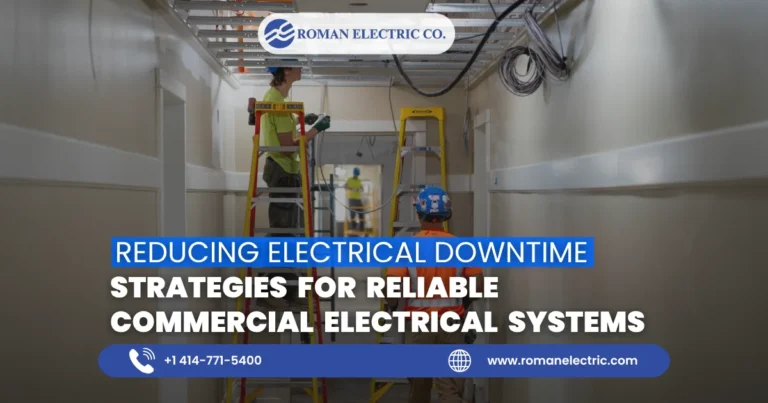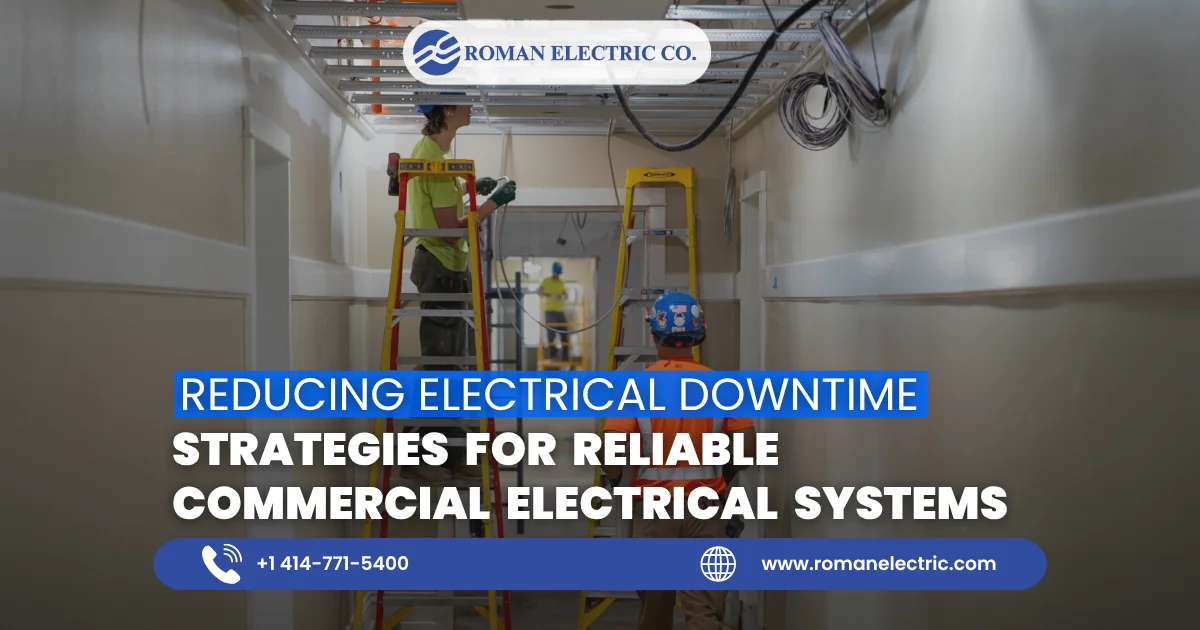
Electrical downtime can stop production, disrupt building operations, harm key equipment, and lead to surprise repairs. For commercial and industrial facilities, reducing electrical downtime is not simply about responding quickly after a failure. It starts with identifying risks before they become outages.
The most effective approach combines preventive electrical maintenance, condition-based diagnostics, timely repairs, electrical system planning, and emergency response. The right mix depends on the facility, equipment, operating schedule, system condition, and consequences of an outage.
This guide covers the main causes of electrical downtime. It also offers practical ways to prevent issues. Plus, it shows how a structured commercial electrical maintenance program can boost system reliability.
Key Takeaways
- Preventive maintenance is the foundation of electrical reliability. Regular inspections, testing, and maintenance can spot issues before they turn into major failures.
- Infrared scanning can show unusual heat, which may signal electrical issues like overloaded parts or loose connections. This lets us check problems before they lead to failure.
- Repeated breaker trips should be investigated, not simply reset. Recurring trips can indicate overloads, short circuits, equipment problems, or other underlying conditions.
- Predictive and preventive maintenance work together. Maintenance schedules offer routine care. Condition-based diagnostics identify areas that need the most focus.
- Backup power lessens the effects of some outages, but it can’t stop the initial electrical failure. It should be part of a broader reliability strategy.
- A qualified commercial electrical contractor can help identify maintenance priorities, troubleshoot recurring problems, and develop a facility-specific reliability plan.
Table of Contents
- What Is Electrical Downtime?
- What Causes Electrical Downtime?
- How to Reduce Electrical Downtime
- How Infrared Scanning Helps Prevent Electrical Failures
- Preventive vs. Predictive vs. Reactive Electrical Maintenance
- Building an Electrical Maintenance Program
- Reducing Downtime in Manufacturing and Commercial Facilities
- When Should Electrical Equipment Be Repaired or Replaced?
- Electrical Safety and Maintenance Considerations
- How Roman Electric Can Help Reduce Electrical Downtime
- Electrical Downtime Reduction Checklist
- Frequently Asked Questions
What Is Electrical Downtime?
Electrical downtime is when an electrical system or equipment can’t work as it should. It may affect an entire facility, a production line, a specific panel, or a single piece of equipment.
Not every electrical interruption has the same cause or consequence. A short lighting interruption in an office is very different from a power failure affecting manufacturing equipment, refrigeration, data systems, life-safety equipment, or other critical loads.
This distinction matters when developing a reliability strategy. The goal is not necessarily to eliminate every possible electrical interruption. Facility managers should find systems where electrical failures could cause major operational, safety, or financial issues. Then, they should prioritise maintenance for those systems.
NFPA 70B provides a framework for electrical equipment maintenance and emphasizes maintenance programs, equipment condition, inspection, testing, documentation, and corrective measures.
What Causes Electrical Downtime?
Electrical downtime rarely comes from one universal failure point. Several conditions can contribute to unexpected outages.
Electrical Overloads
An overloaded circuit or electrical component can experience excessive current and heat. Protective devices may trip and cut the circuit. If overloading continues, the system may need a closer look.
Resetting a breaker over and over doesn’t fix the real issue. If the same circuit continues to trip, the cause should be diagnosed.
Loose Connections and Overheating
Loose electrical connections can create resistance and abnormal heating. Over time, excessive heat can damage components and increase the risk of failure. This is one reason condition-based inspection can be useful. A maintenance team might miss a thermal issue during a regular visual check. However, thermal imaging can spot unusual temperature patterns that need further investigation.
Aging Electrical Equipment
Panels, switchgear, transformers, motor control equipment, wiring, and other components can become less reliable as they age or as operating conditions change. Age alone does not automatically mean equipment should be replaced. Condition, maintenance history, loading, environment, available replacement parts, system capacity, and safety considerations all affect the decision.
Poor Power Quality
Voltage fluctuations, voltage imbalance, harmonics, and other power-quality problems can affect sensitive electrical and electronic equipment. When equipment behaves unpredictably, the solution may not be a simple component replacement. Testing and diagnosis can show if the issue comes from the equipment, the distribution system, or the incoming power.
Inadequate Maintenance
A maintenance program that only fixes failures offers few chances to spot rising issues.
NFPA 70B focuses on preventive maintenance. It aims to prevent equipment failures and ensure that electrical systems operate safely and reliably.
Unexpected Equipment Failure
Even a well-maintained system can experience component failure. That is why downtime reduction requires both prevention and response planning. Emergency response, spare components where appropriate, documented system information, and clear escalation procedures can reduce the time required to stabilize a facility after an unexpected event.
How to Reduce Electrical Downtime
Reducing electrical downtime requires more than adding inspections to a calendar. The maintenance strategy should match the facility’s real equipment, operating conditions, key loads, and past failures.
1. Establish a Preventive Electrical Maintenance Schedule
Identify the electrical equipment that needs regular inspection, testing, servicing, or condition checks.
A maintenance program can include:
- Electrical panels and distribution equipment
- Switchgear
- Transformers
- Motor control centers
- Critical circuits
- Backup power equipment
- Grounding systems
- Lighting and controls
- Equipment connections
- Other facility-specific electrical assets
The schedule should reflect equipment needs, operating conditions, manufacturer advice, relevant standards, and failure impacts. It shouldn’t follow a random, one-size-fits-all approach.
2. Track Recurring Electrical Problems
A recurring breaker trip, an equipment shutdown, overheating parts, or strange voltage issues are key diagnostic clues.
Instead of treating every event as an isolated service call, track:
- What failed
- Where it occurred
- When it occurred
- What equipment was operating
- Whether the problem repeated
- What corrective action was taken
- Whether the same condition returned
Patterns can reveal weaknesses that are easy to miss when maintenance is handled only as individual repair requests.
3. Use Infrared Scanning for Condition-Based Detection
Infrared scanning, also called thermal imaging, can help identify abnormal heat patterns in electrical equipment.
Roman Electric provides infrared scanning as part of its commercial electrical services. This thermal diagnostic tool helps find problems that are hard to spot otherwise.
The important distinction is that a thermal image is a diagnostic tool, not a diagnosis by itself.
If a component appears unusually warm, the next step is to determine why. Possible causes may include loading conditions, connection problems, component defects, imbalance, or other system conditions.
Infrared scanning is most helpful when qualified electrical professionals review the findings. They can then decide on the right corrective action.
4. Investigate Root Causes Instead of Symptoms
A facility can waste considerable time treating symptoms rather than causes.
If a breaker keeps tripping, just replacing it might not fix the real problem.
Root-cause troubleshooting asks questions such as:
- Is the circuit overloaded?
- Is connected equipment malfunctioning?
- Is there a short circuit or ground fault?
- Is a connection loose or damaged?
- Has the electrical load changed?
- Is the protective device correctly selected?
- Is there a power-quality issue?
- Has the equipment been maintained according to its requirements?
This approach turns troubleshooting into reliability improvement rather than repeated emergency repair.
5. Monitor Changes in Electrical Loads
Electrical demand changes as facilities add machinery, charging equipment, HVAC systems, production equipment, technology, or other loads. A system that originally had sufficient capacity may require evaluation after significant changes.
An electrical feasibility study can help before a big expansion or equipment installation. It checks if the current infrastructure can handle the new load and identifies any needed upgrades. Roman Electric lists feasibility studies among its commercial service and maintenance capabilities. It’s better to plan before installation than to find capacity limits after the equipment is set up.
6. Evaluate Power Quality When Equipment Behaves Unpredictably
Not every electrical problem appears as a complete outage.
Equipment may experience:
- Unexpected shutdowns
- Nuisance trips
- Control problems
- Overheating
- Irregular operation
- Sensitive electronics failures
When these symptoms occur repeatedly, power-quality evaluation may be appropriate.
The objective is to determine whether voltage conditions, imbalance, harmonics, equipment interaction, or another electrical issue contributes to the problem.
7. Maintain Critical Electrical Infrastructure
Not every piece of electrical equipment deserves the same maintenance priority.
A practical facility strategy should identify critical loads first.
For example, a facility may place higher priority on electrical systems supporting:
- Manufacturing processes
- Refrigeration
- Data infrastructure
- Medical or healthcare operations
- Security systems
- Life-safety systems
- Essential building systems
This makes a better maintenance hierarchy than just treating all electrical components the same.
8. Plan for Backup Power Where Appropriate
Backup generators, UPS systems, and other backup power solutions keep key loads running when the normal power goes out.
However, backup power is a resilience measure, not a substitute for electrical maintenance.
If the distribution system has a fault, adding backup capacity won’t fix it. The strongest strategy combines reliable primary electrical infrastructure, appropriate maintenance, and backup power for loads that genuinely require continuity.
9. Schedule Repairs Before They Become Emergencies
When inspections or diagnostics identify a developing problem, schedule corrective work during a controlled maintenance window when practical.
This can reduce the likelihood that a manageable repair becomes an emergency interruption.
The exact timing depends on the severity of the condition. A minor issue and an active overheating condition should not receive the same response.
10. Keep Electrical Documentation Current
Good documentation supports faster troubleshooting and better maintenance decisions.
Useful records may include:
- Equipment inventories
- Inspection results
- Testing records
- Maintenance history
- Repair records
- Electrical drawings
- Panel schedules
- Equipment specifications
- Infrared scan findings
- Known recurring problems
- System modifications
Documentation is especially useful when staff change or in emergencies. It helps someone who doesn’t know the system diagnose problems quickly.
Match the Electrical Downtime Strategy to the Problem
Not every electrical asset requires the same maintenance approach. The priority should be based on equipment criticality, current condition, failure history, operating conditions, and the consequences of an interruption. A newer piece of equipment supporting a critical production process may deserve more attention than older equipment serving a low-consequence load.
| If the facility has… | Prioritize… | Why |
| Frequent breaker trips | Root-cause troubleshooting | Repeated trips may indicate overloads, equipment faults, wiring problems, or other unresolved conditions. |
| Abnormal heat readings | Infrared scanning + electrical investigation | Thermal patterns can identify areas that warrant further evaluation before the condition becomes more serious. |
| Unexplained equipment shutdowns | Power-quality evaluation | Voltage fluctuations, imbalance, harmonics, or equipment interaction may contribute to recurring problems. |
| Aging electrical equipment | Condition assessment + maintenance planning | Age alone does not determine replacement. Condition, reliability, capacity, maintenance history, and parts availability also matter. |
| Major equipment additions planned | Electrical feasibility study | Evaluating capacity before installation can identify potential limitations before they affect operations. |
| Critical production equipment | Preventive + condition-based maintenance | Equipment supporting critical processes may justify a higher maintenance priority because the consequences of failure are greater. |
| Repeated emergency repairs | Reliability review | Frequent failures can indicate an underlying system problem rather than a series of unrelated events. |
| Critical loads requiring continuity | Backup-power assessment | Backup systems can reduce the operational impact of an interruption, although they do not eliminate the underlying electrical failure. |
The goal is not to perform every maintenance activity on every asset. It is to direct attention where failure risk and downtime consequences are highest. This approach helps facilities use maintenance resources more effectively while avoiding a one-size-fits-all program.
How Infrared Scanning Helps Prevent Electrical Failures
Infrared scanning uses thermal imaging to identify abnormal heat patterns that may indicate electrical problems before failure occurs. Findings should be properly investigated by qualified personnel.
Preventive maintenance uses scheduled inspections, testing, servicing, and repairs to reduce avoidable failures. The schedule should reflect equipment condition, operating conditions, and criticality.
Predictive or condition-based maintenance uses equipment condition and diagnostic data to identify problems that may require attention. Infrared scanning can support this approach alongside other appropriate diagnostics.
Reactive maintenance restores operation after a failure occurs. While necessary for unexpected problems, it should not be the primary strategy for improving electrical reliability.
How the Approaches Work Together
Preventive maintenance provides the foundation, while condition-based diagnostics help identify changing conditions. Infrared scanning can support early detection, and reactive maintenance addresses failures that still occur. The goal is to reduce failures and minimize downtime when problems arise.
Building an Electrical Maintenance Program
A good electrical maintenance program should be tailored to the facility, not just copied from a generic checklist.
Begin by making a list of equipment. Identify which systems are essential for operations. Then determine the maintenance, inspection, and testing requirements for those assets.
A practical program should address:
- Asset identification: What electrical equipment is installed?
- Criticality: Which failures would create the greatest operational or safety consequences?
- Condition: What is the current state of each important asset?
- Maintenance requirements: What inspection, testing, and servicing are appropriate?
- Failure history: Which problems have occurred repeatedly?
- Corrective actions: What issues need to be repaired or monitored?
- Documentation: Where are findings and maintenance records stored?
- Review: Are failures and maintenance findings changing future priorities?
NFPA’s maintenance framework includes identifying responsible personnel, surveying equipment, establishing maintenance procedures, planning inspection and testing, retaining documentation, and incorporating corrective measures. That makes maintenance an ongoing management process, not just a series of separate service calls.
Reducing Downtime in Manufacturing and Commercial Facilities
The consequences of electrical downtime vary by facility.
In a manufacturing environment, an electrical interruption may affect production equipment, controls, motors, material handling, or other connected systems. Repeated electrical issues might show a bigger problem. This could be with distribution, equipment loading, or power quality.
Commercial buildings may have different priorities. Building owners and facility managers may be more concerned with lighting, HVAC, elevators, security, access systems, tenant operations, and other building infrastructure.
Healthcare and other vital settings need extra focus on key electrical systems and essential loads.
The maintenance strategy should begin with the needs of the electrical system to keep it running, not with a standard list of services.
When Should Electrical Equipment Be Repaired or Replaced?
Repair versus replacement should be based on condition and risk rather than age alone.
Factors to consider include:
- Severity of the problem
- Equipment condition
- Availability of replacement components
- Maintenance history
- Safety concerns
- System capacity
- Reliability requirements
- Compatibility with existing infrastructure
- Cost and disruption of continued repairs
- Planned facility expansion
Repeated failures are particularly important. If a component keeps causing outages despite fixes, we might need to evaluate the whole system instead of just making another repair.
This is where feasibility studies and professional electrical assessments can help facility managers make a more informed capital-planning decision.
Electrical Safety and Maintenance Considerations
Electrical maintenance should never be treated as an ordinary do-it-yourself facility task.
OSHA defines a qualified person based on appropriate training and demonstrated skills and knowledge concerning electrical equipment, installations, and associated hazards. OSHA states when qualified people must work on electrical equipment.
NFPA’s Electrical Cycle of Safety highlights the roles of NFPA 70, NFPA 70B, and NFPA 70E. NFPA 70 focuses on electrical installation. NFPA 70B covers equipment maintenance. NFPA 70E addresses workplace electrical safety.
For facility managers, the practical takeaway is straightforward: maintenance planning should account for both equipment reliability and worker safety. The correct procedures, qualified personnel, de-energization practices, testing requirements, and applicable standards depend on the work being performed and the equipment involved.
How Roman Electric Can Help Reduce Electrical Downtime
Reducing electrical downtime often requires more than emergency repair after a failure occurs. Roman Electric’s commercial service and maintenance division provides preventive maintenance, troubleshooting and repair, infrared scanning, feasibility studies, Arc Flash & Coordination Studies, energy-efficiency lighting upgrades, and 24/7 emergency response.
That combination supports a broader reliability approach:
Inspect → Diagnose → Prioritize → Repair → Document → Maintain
For facility managers in Milwaukee and Southeastern Wisconsin, this can provide a practical path from recurring electrical problems toward a more structured maintenance strategy.
The goal is not to promise that every outage can be prevented. The goal is to spot avoidable risks sooner, keep critical equipment in good shape, and have a plan ready for unexpected failures.
Electrical Downtime Reduction Checklist
Use this checklist as a starting point for reviewing your facility’s electrical reliability:
- Maintain an up-to-date electrical equipment inventory
- Identify critical electrical loads
- Establish a preventive maintenance schedule
- Track recurring breaker trips and electrical faults
- Investigate repeated failures instead of repeatedly resetting equipment
- Consider infrared scanning where condition-based inspection is appropriate
- Evaluate power-quality problems when equipment behaves unpredictably
- Review electrical capacity before major equipment additions
- Document inspections, repairs, and diagnostic findings
- Prioritize repairs based on risk and equipment criticality
- Evaluate backup power requirements for critical loads
- Keep electrical drawings and equipment information current
- Use qualified personnel for applicable electrical maintenance and testing
- Review maintenance findings regularly and update priorities
Frequently Asked Questions
What is the best way to reduce electrical downtime?
There is no single method that works for every facility. A strong starting point is a structured electrical maintenance program that combines preventive maintenance, condition-based diagnostics, root-cause troubleshooting, timely repairs, documentation, and appropriate backup-power planning.
How does preventive maintenance reduce electrical downtime?
Preventive maintenance helps identify and address developing electrical problems before they become unexpected failures. The specific maintenance requirements depend on the equipment, operating conditions, manufacturer guidance, applicable standards, and facility risk.
Can infrared scanning prevent electrical failures?
Infrared scanning can help identify abnormal thermal conditions that warrant further investigation. It doesn’t guarantee that failure will be avoided. A thermal finding should be looked at with electrical conditions and other diagnostic details.
Should a business rely on backup generators to prevent downtime?
Backup generation can keep important loads running during an outage. However, it won’t stop failures in the main electrical system. Backup power is just one part of a bigger plan for electrical reliability and business continuity.
When should a commercial facility schedule an electrical assessment?
An assessment may be appropriate when a facility experiences recurring electrical failures, unexplained equipment behavior, capacity concerns, significant equipment additions, aging infrastructure, or repeated emergency repairs. The appropriate scope depends on the facility and the problem being investigated.
How can a commercial electrical contractor help reduce downtime?
A qualified contractor can inspect and diagnose electrical systems, perform appropriate maintenance and testing, investigate recurring problems, recommend corrective work, evaluate system capacity, and provide emergency response when failures occur.
Reduce the Risk of Unexpected Electrical Downtime
Electrical reliability is built over time. Preventive maintenance, condition-based diagnostics, accurate documentation, root-cause troubleshooting, and appropriate system planning can help facilities identify problems before they become disruptive failures.
Roman Electric provides commercial electrical maintenance, infrared scanning, troubleshooting and repair, feasibility studies, Arc Flash & Coordination Studies, and 24/7 emergency response for commercial and industrial customers. Reduce the risk of unexpected electrical downtime with a proactive maintenance strategy. Contact Roman Electric to check your commercial electrical system. They can spot issues and create a maintenance plan just for your facility.