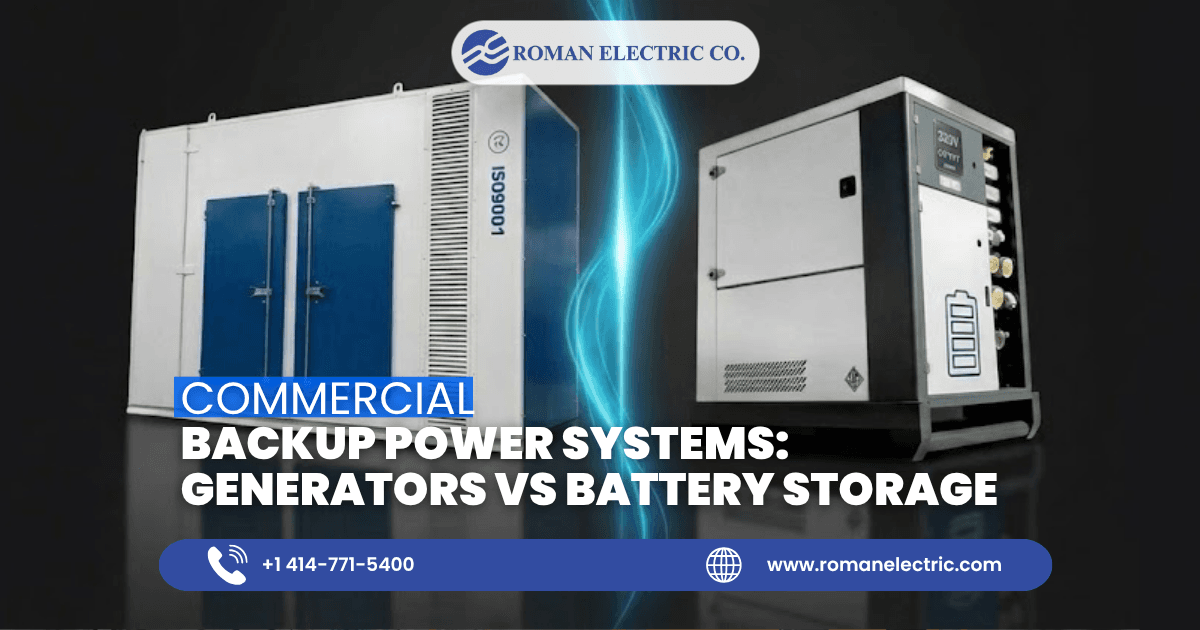
Power goes out. It happens to every business at some point. And when it does, the cost adds up fast – lost sales, spoiled inventory, stopped production, unhappy customers, and in some industries, genuine safety risks. That’s why Commercial Backup Power Systems are no longer optional for serious businesses. The real question isn’t whether you need one. It’s which type is right for your operation. This guide breaks down the two main options – generators and battery storage – so you can make a smart decision based on your actual needs.
Why Every Business Needs a Backup Power Plan
Most businesses don’t think about backup power until the lights go out at the worst possible moment.
A restaurant loses a full walk-in fridge of food. A medical clinic can’t access patient records. A data centre goes offline. A manufacturing line stops mid-run and loses an entire batch.
Every one of those scenarios costs real money. And most of them are completely preventable with the right Commercial Backup Power Systems in place.
Power outages are getting more frequent too – not less. Ageing grid infrastructure, extreme weather events, and increased demand all contribute to more frequent and longer outages across the country.
At Roman Electric, we help businesses assess their power needs and install backup systems that actually hold up when the grid fails.
The Two Main Options: Generators vs Battery Storage
When it comes to Commercial Backup Power Systems, two technologies dominate the market right now.
Generators – engine-driven machines that burn fuel to produce electricity on demand.
Battery storage systems – large banks of batteries that store electricity and release it when grid power fails.
Both work. Both have real strengths. And both have genuine limitations. The right choice depends on your business – how much power you need, how long you need it, how fast it has to kick in, and what your budget looks like.
Commercial Generators – How They Work and What They Do Well
A commercial generator is essentially an engine connected to an alternator. Fuel goes in – diesel, natural gas, or propane – and electricity comes out.
When grid power fails, an automatic transfer switch detects the outage and starts the generator. Most commercial units start within 10 to 30 seconds.
Strengths of Commercial Generators
Long runtime. This is the big one. As long as fuel is available, a generator keeps running. Hours. Days. Weeks if needed. For businesses in areas with extended outage risk – severe weather regions, rural locations, critical infrastructure – this is a significant advantage.
High power output. Generators scale up easily. Large commercial units can power entire facilities – HVAC, heavy equipment, lighting, data systems, everything. Battery systems struggle to match this at comparable cost.
Lower upfront cost. For the amount of power delivered, generators are generally cheaper to purchase and install than equivalent battery systems.
Proven technology. Commercial generators have been running businesses through outages for decades. The technology is mature, well-understood, and widely serviced.
Limitations of Generators
Startup delay. That 10 to 30 second gap between outage and generator startup causes problems for sensitive equipment. Computers reset. Systems drop. Some operations can’t tolerate even a brief interruption.
Fuel dependency. No fuel means no power. During extended disasters, fuel supply chains get disrupted. Diesel can also degrade in storage if not properly maintained.
Emissions and noise. Generators produce exhaust and make noise. Zoning restrictions, indoor installation limitations, and environmental regulations all affect where and how they can be used.
Maintenance requirements. Engines need regular servicing – oil changes, filter replacements, load bank testing, fuel system maintenance. Skipping maintenance is how generators fail when they’re needed most.
Battery Storage Systems – How They Work and What They Do Well
Commercial battery storage systems – most commonly lithium-ion – charge from the grid during normal operation and discharge automatically when grid power fails.
The switchover is essentially instant. No startup delay. No gap.
Strengths of Battery Storage Systems
Instant response. The moment grid power fails, battery systems switch over in milliseconds. No interruption. No reset. Critical for data centres, medical equipment, and any process that can’t tolerate even a brief gap.
Silent and clean. No exhaust. No noise. No fuel. Battery systems can be installed indoors, in urban environments, and in locations where generators aren’t permitted.
Lower operating costs. No fuel. Minimal moving parts. Maintenance requirements are significantly lower than a generator over the system’s lifetime.
Grid interaction. Modern battery systems can participate in demand response programmes – reducing energy costs during peak rate periods even when there’s no outage. Some systems pay back part of their cost through these programmes.
Limitations of Battery Storage Systems
Limited runtime. A battery system has a finite capacity. Once depleted, it’s done until recharged. For outages lasting more than a few hours, most commercial battery systems run out of power.
Higher upfront cost. For equivalent power output, battery storage currently costs more to purchase and install than a generator. Prices are falling – but the gap is still significant for high-power applications.
Degradation over time. Battery capacity decreases with charge cycles and age. A system installed today will have less capacity in ten years. Replacement costs need to be factored into long-term planning.
Side-by-Side Comparison
| Feature | Generator | Battery Storage |
| Startup time | 10 – 30 seconds | Milliseconds |
| Runtime | Unlimited (with fuel) | Limited by capacity |
| Power output | Very high | Moderate to high |
| Upfront cost | Lower | Higher |
| Operating cost | Higher (fuel + maintenance) | Lower |
| Noise | Significant | Silent |
| Emissions | Yes | None |
| Indoor installation | Limited | Yes |
| Maintenance | Regular servicing needed | Minimal |
| Best for | Long outages, high power needs | Short outages, sensitive equipment |
Which One Is Right for Your Business
This depends on four things: outage duration risk, power requirements, sensitivity of equipment, and budget.
Choose a Generator If
Your business is in an area where outages regularly last more than a few hours. You run heavy equipment or HVAC systems that need high power output. Your budget favours lower upfront cost. You have outdoor space or a ventilated area for installation.
Choose Battery Storage If
Your equipment cannot tolerate even a brief interruption – medical devices, data systems, precision manufacturing. You’re in an urban environment with noise or emissions restrictions. Your outages are typically short. You want to reduce energy costs through demand response even when there’s no outage.
Consider Both Together
The strongest Commercial Backup Power Systems often combine both technologies. Battery storage provides instant, seamless switchover and covers the first few hours of an outage quietly and cleanly. The generator starts up and takes over for extended outages – recharging the battery system as it runs.
This hybrid approach eliminates the weaknesses of both technologies individually. The battery covers the startup gap and handles short outages. The generator handles the long ones.
Roman Electric designs and installs both generator systems and battery backup solutions – and can help you determine whether a single technology or a hybrid approach makes sense for your specific facility.
The National Electrical Manufacturers Association publishes standards and guidance for commercial backup power equipment – a useful reference when specifying systems and verifying product compliance.
Key Factors to Assess Before Choosing
Before making any decision, work through these questions:
What loads need to be backed up? Not everything in your building may need backup power. Identify the critical loads – the equipment and systems that absolutely cannot go down – and size your backup system around those.
How long do outages typically last in your area? Check with your utility provider. Short, frequent outages suggest battery storage. Long, rare outages suggest a generator. Unpredictable outage patterns suggest a hybrid system.
What are your installation constraints? Indoor or outdoor? Urban or rural? Noise-sensitive neighbours? Emissions restrictions? These factors narrow your options before cost even enters the picture.
What’s your total budget – upfront and ongoing? Factor in installation, fuel, maintenance, and eventual replacement costs. The cheapest system to buy is not always the cheapest system to own over ten years.
Do you have regulatory requirements? Healthcare facilities, data centres, and some manufacturing operations have legally mandated backup power requirements. Make sure your system meets them.
FAQs About Commercial Backup Power Systems
How long does a commercial generator last?
With proper maintenance, most commercial generators last 20 to 30 years. Regular servicing is what makes that lifespan achievable.
How often should backup generators be tested?
Monthly under load for at least 30 minutes. Annual full-load testing is also recommended to verify capacity.
How long do commercial battery storage systems last?
Most lithium-ion commercial systems are rated for 10 to 15 years or a set number of charge cycles – whichever comes first.
Can battery storage power an entire commercial building?
For short periods – yes, depending on system size. For extended outages or high-power facilities, battery storage alone is usually not sufficient.
What fuel is best for commercial generators?
Natural gas is convenient and doesn’t require on-site storage. Diesel provides more energy density and is better for remote locations. Propane is a good middle ground.
Conclusion
Power failures don’t announce themselves. They happen at the worst time, on the worst day, with the worst timing for your business. Having the right Commercial Backup Power Systems in place means the difference between a minor inconvenience and a serious, costly disruption. Generators offer long runtime and high power output at lower upfront cost. Battery storage offers instant response, clean operation, and low maintenance.
The best solution for many businesses combines both. Start by understanding your critical loads, your outage risk, and your installation constraints. Then make a decision based on real data – not guesswork. Commercial Backup Power Systems are too important to your business continuity to get wrong – and getting expert guidance from a qualified electrical contractor from the start makes all the difference.